Private pilot · Decision intelligence for global trade
See where demand is.Understand your competitive position.Test what could change.
Starting with Food & Beverage. The current technical pilot uses Pasta · HS4 1902 while broader Food & Beverage coverage is being prepared for private beta.
Export Export Export connects official trade data, market comparison and explicit company simulations so export teams can investigate a decision rather than be handed an answer.
Food & Beverage pilot evidence · Pasta · HS4 1902. Pasta, couscous and similar preparations — one heading, in depth, rather than a catalogue in outline. Official trade data plus demonstration company economics. Sources and methodology.
Questions with answers you can argue with
Each one is a separate question against observed data, with its inclusion rule printed beside the result. Two of them can order the same markets in opposite directions, and that is the point — a single blended number would hide the judgement inside a weighting nobody can inspect.
- Where demand is largest, and where it is growing
- Where Italy is gaining or losing share against the other suppliers on the shelf
- Which markets satisfy the decision criteria you declare
- How changing one of those assumptions changes the decision set
- How a company’s own cost structure affects margin, market by market
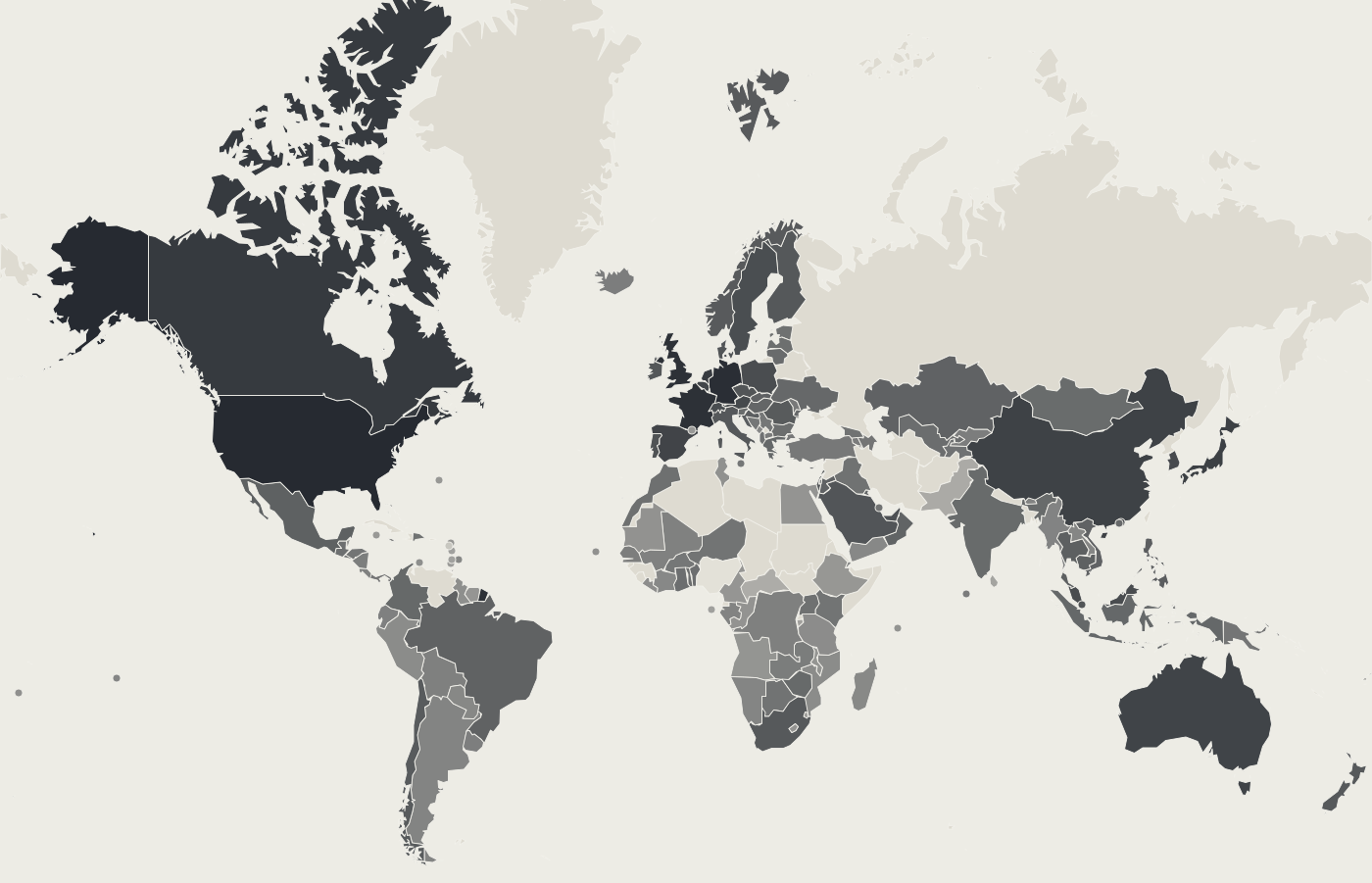
67 of 175 markets clear the declared criteria
Run below on the pilot data for 2023, asking “Where is observed demand largest?” at the Established markets gate. The gates are hard thresholds, not weights: a market either clears them or it does not, and the ones that do not carry the reason they failed rather than a lower position.
| Market | Observed imports | Italy’s share | Supplier detail |
|---|---|---|---|
| USA | $1.63bn | 41.1% | Available |
| Germany | $1.27bn | 54.9% | Available |
| United Kingdom | $1.09bn | 51.0% | Available |
| France | $1.08bn | 49.3% | Available |
| Canada | $626.6m | 13.2% | Available |
Why the others are not here
- 97Observed imports are below the established markets floor of $25m.
- 11This market reported no imports of the heading in 2023, so its size is unknown rather than small.
- 11The measure this objective orders by could not be formed from what this market reported.
A market excluded for size is not a market judged worse. It is a market this question cannot answer at this threshold — which is why the threshold is yours to move.
Move one assumption, and watch the set move
Changing the size gate from Established markets ($25m) to Major markets ($100m) takes the set from 67 markets to 29. The product shows you that before you rely on the first number.
Stable across every adjacent assumption: USA, Germany, United Kingdom, France. These stay in the set however the gates move one step — which is a stronger statement than any position in a list.
Six steps, and you can stop at any of them
Each step states what it used and what it could not establish. Nothing is carried forward silently, and the session never leaves your browser.
- 1Profile
- 2Assessment
- 3Markets to examine
- 4Compare
- 5Decision guidance
- 6Strategy workspace
Everything on screen can be traced back
- Official nomenclatureCodes and descriptions come from the Combined Nomenclature, 8 editions deep, with the lifecycle of each code recorded.
- Official trade dataUN Comtrade for world imports, Eurostat Comext for Italian exports. Endpoints and request parameters are recorded with the snapshot.
- Observed versus derivedA declared figure and a calculated one are labelled differently, and a derived figure carries the formula that made it.
- Explicit assumptionsDemonstration values are marked as demonstration values, and the worked example states its classification assumptions before it picks a code.
- Missing evidence is shownWhere a market has no partner breakdown the product says so, rather than filling the gap with an estimate that would look like an observation.
- No black-box scoreMarkets clear hard gates or they do not. There is no blended index, no weighting, and nothing here is predicted.
Food & Beverage
1 of 16 catalogued Food & Beverage families is in private pilot. The other 15 have had their customs scope verified and hold no trade data yet.
- Pasta1902In private pilot
- Cheese0406Planned for Food & Beverage beta
- Coffee0901Planned for Food & Beverage beta
- Olive oil1509, 1510Planned for Food & Beverage beta
- Sausages1601Planned for Food & Beverage beta
- Prepared meat1602Planned for Food & Beverage beta
- Chocolate1806Planned for Food & Beverage beta
- Bakery products1905Planned for Food & Beverage beta
- Prepared tomatoes2002Planned for Food & Beverage beta
- Prepared vegetables2005, 2001, 2004Planned for Food & Beverage beta
- Prepared fruit and nuts2008Planned for Food & Beverage beta
- Sauces and condiments2103Planned for Food & Beverage beta
- Mineral water2201Planned for Food & Beverage beta
- Beer2203Planned for Food & Beverage beta
- Wine2204Planned for Food & Beverage beta
- Spirits2208Planned for Food & Beverage beta
What these labels mean. In private pilot — Real observed data, used to build and verify the system. A pilot, not the vertical. Planned for Food & Beverage beta — Customs scope verified against the official nomenclature. No trade data acquired yet, and no date attached. A credible Food & Beverage launch needs 12 or more families at full evidence; the catalogue is sized at 16 to reach it. Nothing here is scheduled.
What this can and cannot tell you today
Stated before you ask for access, not after. The pilot is deep on one heading rather than shallow across a catalogue, and that choice has consequences worth knowing in advance.
- Platform
- Decision intelligence for global trade. The capabilities — market intelligence, decision guidance, comparison, scenarios — are not specific to any one sector.
- First vertical
- Food & Beverage. 15 product families are catalogued and their customs scope verified against the Combined Nomenclature. None of them holds trade data yet.
- Technical pilot
- Pasta — HS heading 1902, pasta, couscous and similar preparations. The one family with real data behind it, and the reason every figure on this page exists. It is not the vertical.
- Coverage
- $13.86bn of observed imports across 164 reporting markets in 2023, of which 30 carry the partner breakdown.
- Reference year
- 2023 is complete. 2024 is partial — not every reporter has filed — and is labelled partial everywhere it appears.
- Company economics
- A demonstration. One SKU with a price and five unit costs across 8 markets, showing the engine working. It describes no real business, and no advice specific to a company is produced from it.
- Decision gates
- Major markets ($100.0m and above), Established markets ($25.0m and above), Broader exploration ($10.0m and above). Yours to choose, and yours to move.
- Access
- Limited early access, in small groups. The platform is a pilot and is not yet behind a sign-in, so nothing in it should be treated as confidential.
Early access opening soon
Six short answers. The last one — what decision you are trying to make — is the one we actually read, because it tells us whether the pilot can help you yet or whether we would be wasting your time.
Early access opening soon
We are not collecting requests yet. The pilot runs on one customs heading and early access will open in small groups; when the list opens, this is where it will be. Nothing is recorded on this page today — there is no form here to submit, and no cookie is set.